

Introduction
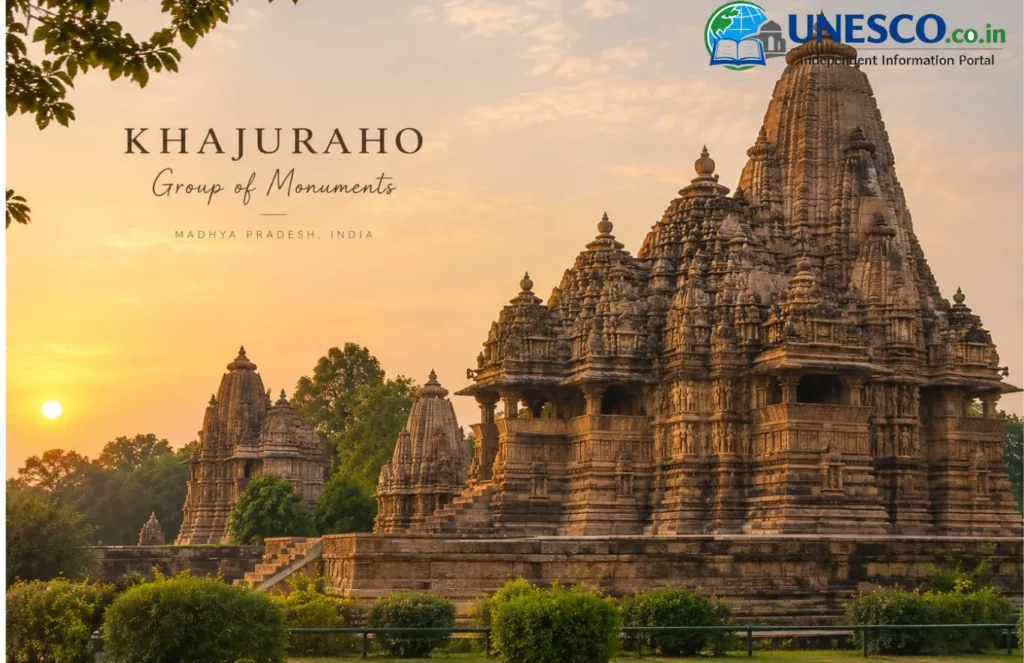
The Khajuraho Group of Monuments, located in Madhya Pradesh, is a wonderful example of architecture, art, and cultural heritage. The temples here were built during the 10th and 11th centuries during the reign of the Chandela dynasty. The Khajuraho temple is currently one of India’s cultural heritages. In 1986 the Khajuraho Group of Monuments was declared a UNESCO World Heritage Site. In this way Khajuraho is not just a group of temples but it is a living heritage of medieval India’s art, architecture, culture, religious tradition, and lifestyle. The uniqueness of Khajuraho is found not only in its carvings but also in its beautiful Nagara style of temple architecture.
Khajuraho Group of Monuments
The monuments of Khajuraho are primarily divided into three temple groups — the Western Group, the Eastern Group, and the Southern Group. Each group features distinct types of temples and sculptures. Together, these three groups showcase the rich religious, artistic, and architectural heritage of Khajuraho.
Western Group of Temples
The Western Group is the most famous and most visited part of Khajuraho. It houses several magnificent Hindu temples. The temples in this group are renowned for their massive structures, beautiful spires (shikharas), and intricate stone carvings. Important temples located here include the Kandariya Mahadev Temple, Lakshmana Temple, Vishvanatha Temple, and Jagadambi Temple.
South Group Of Temples
The Southern Group of temples at Khajuraho is one of the three main temple groups. Compared to the Western and Eastern groups, this group is smaller and situated somewhat apart from the main temple area. Nevertheless, it holds great significance in understanding Khajuraho’s architectural tradition and religious heritage. The Southern Group, specifically the Duladeo and Chaturbhuj temples, is included in the UNESCO World Heritage property.
Also Read:historic-monuments-of-ancient-kyoto/
Unesco World Heritage Site
The Khajuraho Group of Monuments was included in the UNESCO World Heritage List in 1986 due to its exceptional historical, architectural, and artistic significance. According to UNESCO, the temples of Khajuraho represent a significant achievement in the development of North Indian temple architecture and Chandela-era art. These temples feature the Nagara style of architecture, where high shikhara (spires), decorated platforms, and the well-organized layout of different temple sections play an important role. An extensive variety of carvings can be seen on almost every exterior surface. In addition to religious themes, these sculptures also depict dance, music, social life, and human activities.
Traveling Tips
The weather from October to March is very pleasant and cool, making it an ideal time to explore the temple complex. It is best to avoid visiting during the summer due to the intense heat. Early in the morning, the sunlight beautifully highlights the intricate carvings on the temples, and there are fewer crowds. In the evening, one should definitely experience the Light and Sound show held at the Western Group of Temples. Since footwear must be removed when climbing onto the temple platforms or entering the inner sanctum garbhagriha, it is advisable to carry socks to protect your feet from the stones, which can get hot under the sun.
Also Read:fatehpur-sikri-the-city-of-mughal-grandeur
Conclusion
The Khajuraho Group of Monuments stands as a magnificent example of India’s rich history and cultural heritage. Developed during the Chandela era, these temples continue to narrate the story of medieval India’s art and creativity through their grand architectural design and exquisite stone carvings. A defining feature of Khajuraho is the seamless integration of art and architecture. Following its inclusion in the UNESCO World Heritage List in 1986 Khajuraho, secured its place among the world’s significant cultural heritage sites.