
Introduction
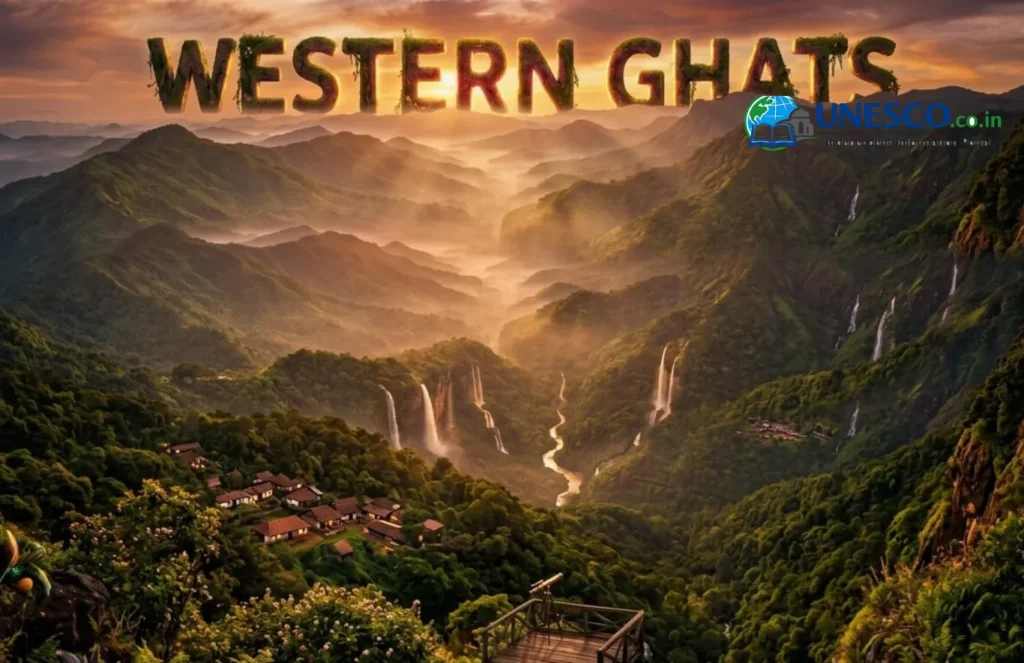
The Western Ghats is a very ancient and vast mountain range located along the western coast of India.This mountain range is also known as the Sahyadri mountain range. It spans a length of 1,600 km, extending from the Tapi River in Gujarat through Maharashtra, Goa, Karnataka, Kerala, and Tamil Nadu, all the way to Kanyakumari.
Location
The Western Ghats mountain range stretches roughly parallel to the western coast of the Indian subcontinent. It begins in the southern part of Gujarat and extends through Maharashtra, Goa, Karnataka, Kerala, and Tamil Nadu. The total length of the Western Ghats is approximately 1,600 kilometers. The Arabian Sea lies on one side, while the vast plains of South India lie on the other. This mountain range is crucial not only from a geographical perspective but also for India’s climate, water resources, and biodiversity.
Rich Biodiversity
The Region considered one of the world’s most important biodiversity hotspots. A variety of forests, grasslands, wetlands, and mountain ecosystems are found here. Due to these diverse habitats, the region is home to countless plant and animal species. A distinctive feature of the Western Ghats is the presence of numerous endemic species. Endemic species are those that are naturally confined to a specific geographic area.
Also Read:jantar-mantar
Importance of the Western Ghats
Heavy rainfall and high mountains in the Western Ghats give rise to numerous rivers; the catchment areas of major rivers like the Godavari, Kaveri, and Krishna are linked to the Western Ghats. These rivers supply water to regions across western and southern India, serving needs such as drinking, agriculture, irrigation, industry, and hydroelectric power generation. The Western Ghats also facilitate the percolation of water into the ground; consequently, they serve as a vital “water tower” for southern India.
UNESCO World Heritage Side
The Western Ghats were recognized as a UNESCO World Heritage Site in 2012; they were designated as a natural heritage site due to their biodiversity and ecological importance. Specific areas within the Western Ghats are included in the UNESCO listing.
Best time to visit
The period from October to February is considered the best time to visit the Western Ghats, as the region boasts beautiful greenery, pleasant weather, and favorable conditions for travel. The weather is generally pleasant during this time, creating ideal conditions for activities such as sightseeing, trekking, nature walks, and wildlife exploration. The cool and pleasant weather, particularly from December to February, ensures a more comfortable experience for travelers.
Also Read:darjeeling-himalayan-railway
Important Points For Visitors
🌦️ Check Weather Conditions
👟 Wear Comfortable Shoes
🧴 Carry Essential Items
🌿 Follow Forest & Nature Rules
🚯 Avoid Plastic & Littering
🐘 Maintain a Safe Distance from Wildlife
📸 Follow Photography Rules
🗺️ Plan Your Route in Advance
🏕️ Use Authorized Guides
📱 Carry a Fully Charged Phone
Thank You For Visiting Website
Thank you for taking the time to explore our website! The Western_Ghats play a critical role in nurturing India’s ecosystems, river systems, and natural heritage. We hope the information provided here serves as a useful resource for your travel plans and research.