
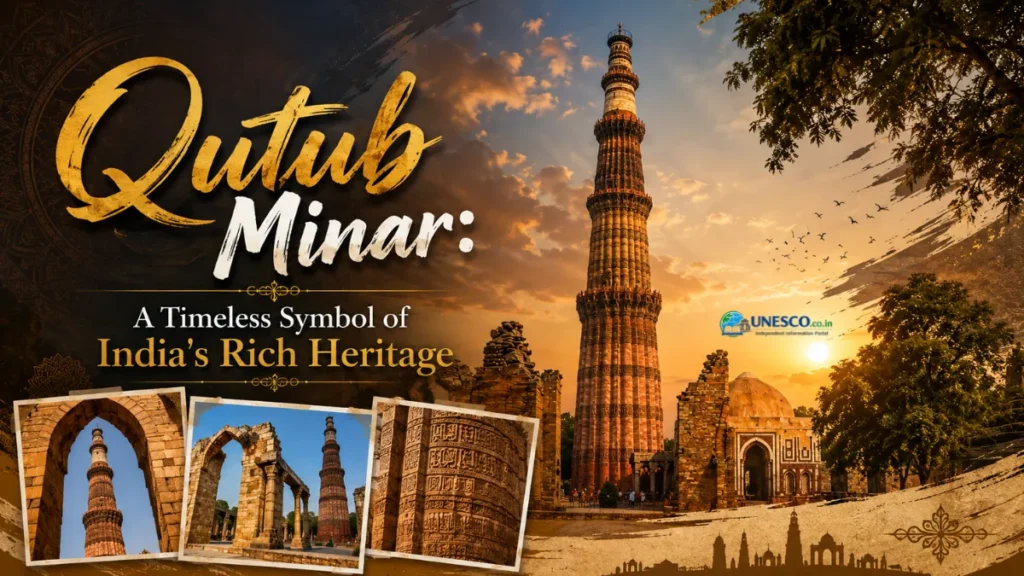
Welcome to Qutub Minar
Welcome to our guide on Qutub Minar, one of India’s most iconic historical landmarks and a UNESCO World Heritage Site. Here, you’ll discover the fascinating history, stunning architecture, interesting facts, and travel information about this magnificent monument. Whether you are a history lover, a student, or a traveler, we hope this guide helps you explore the timeless beauty of Qutub Minar.
Introduction to Qutub Minar
Qutub Minar is one of the most famous historical monuments in India. It is located in Mehrauli, Delhi, and stands at a height of 72.5 meters, making it the tallest brick minaret in the world. Every year, millions of visitors come to admire its beauty, history, and remarkable architecture.
History of Qutub Minar
The construction of Qutub Minar began in 1199 CE under Qutb-ud-din Aibak, the founder of the Delhi Sultanate. He completed only the first storey. Later, his successor Iltutmish added three more storeys, and the top section was rebuilt by Firoz Shah Tughlaq after it was damaged by lightning. Over the centuries, the monument has survived natural disasters and remains a symbol of Delhi’s rich history.
Qutub Minar Visit Timing
| Timing Types | TIME |
| Opening Time | 05:00 AM |
| Closing Time | 07:00 PM |
Who Built Qutub Minar?
Qutb-ud-din Aibak started building Qutub Minar in 1199 CE. After his death, Sultan Iltutmish continued the work and completed most of the tower. Later, Firoz Shah Tughlaq repaired and restored the upper part after it was damagWho Built Qutub Minar? Qutb-ud-din Aibak started building Qutub Minar in 1199 CE. After his death, Sultan Iltutmish continued the work and completed most of the tower. Later, Firoz Shah Tughlaq repaired and restored the upper part after it was damaged.
Architecture of Qutub Minar
Qutub Minar is built mainly of red sandstone, while the upper levels also include marble. The tower has five storeys, each with a projecting balcony. Beautiful carvings, Arabic calligraphy, and geometric patterns decorate its walls, reflecting the artistic excellence of medieval India.
UNESCO World Heritage Status
Qutub Minar and its surrounding monuments were declared a UNESCO World Heritage Site in 1993. The site is recognized for its outstanding historical significance, unique architecture, and cultural value. It is one of India’s most visited heritage monuments.
Interesting Facts About Qutub Minar
It is the tallest brick minaret in the world.
The tower is about 72.5 meters high.
It has 379 steps leading to the top, though visitors are no longer allowed to climb them.
The nearby Iron Pillar has resisted rust for more than 1,600 years.
The monument attracts millions of visitors every year.
Best Time to Visit Qutub Minar
The best time to visit Qutub Minar is between October and March when the weather in Delhi is pleasant. Early mornings and evenings offer a comfortable experience and are ideal for photography.
Also read: AHMEDABAD:INDIA’S FIRST UNESCO WORLD HERITAGE CITY
How to Reach Qutub Minar
Qutub Minar is easily accessible from all parts of Delhi. The nearest metro station is Qutub Minar Metro Station on the Yellow Line. Visitors can also reach the monument by taxi, bus, or auto-rickshaw.
Travel Tips for Visitors
Wear comfortable shoes, carry drinking water, and visit during the cooler hours of the day. Follow the monument’s rules, avoid touching ancient structures, and keep the surroundings clean to help preserve this historic site.
Also read: TAJ MAHAL HISTORY-Taj Mahal-A Timeless Symbol of LOVE
Conclusion
Qutub Minar is a remarkable symbol of India’s rich history, architectural brilliance, and cultural heritage. Its impressive design and fascinating past make it a must-visit destination for anyone exploring Delhi. A visit to Qutub Minar offers a memorable journey into India’s medieval history.
Thank You for Visiting My Website
Thank you for visiting our website and exploring the incredible heritage of Qutub Minar. We hope this guide has helped you learn more about its fascinating history, stunning architecture, and cultural importance.